Artificial Intelligence
YouTube’s New AI Music Labeling: What You Need to Know
Share
TL;DR
-
YouTube Music began rolling out labels on October 14, 2026, for songs substantially created with generative AI.
-
The player-page notice can be tapped for context, with labels also planned for the main YouTube app.
-
Fully Gen AI means AI generated the complete work; Partly Gen AI covers mixed human and generative contributions.
-
No Gen AI can include standard pitch correction or automated mastering without generative content.
-
Music partners disclose through delivery metadata or YouTube Studio; YouTube can also use detection signals.
-
The labels may improve listener choice, although bias, incomplete disclosures, and misclassification remain concerns.
Introduction
Artificial intelligence (AI) is seeping into every form of content. Drafting full-fledged articles and business presentations was just the beginning.
The technology has evolved to be able to generate videos that would make big-budget Hollywood blockbuster production houses jealous. Meanwhile, it can generate songs and audio files in the voice of long-gone singers, leaders, or just about anyone, all done instantly.
Remember the scene from Terminator 2: Judgment Day where a young John Connor thinks he's on a call with his foster mother but is actually talking to a robot sent from the future to kill him, that can mimic anyone's voice.
Luckily, he was saved by another robot sent from the future to protect him, who was in turn mimicking John's voice to validate if the speaker was a human or a robot.
In the real world, it's becoming tough to determine if a voice is genuinely the person who is being portrayed or not. To tackle this obstacle, YouTube has taken a major step by adding new labels for AI music to boost transparency.
So, what information will these AI labels make clearer, and how will it help the listening experience? Tune in to find out!
What Are YouTube’s New AI Music Labels?
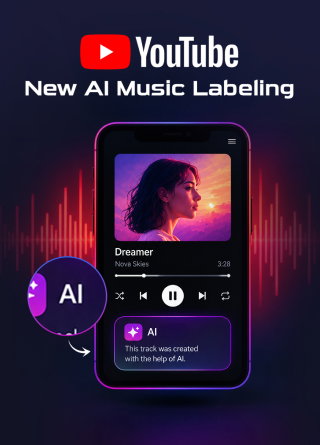
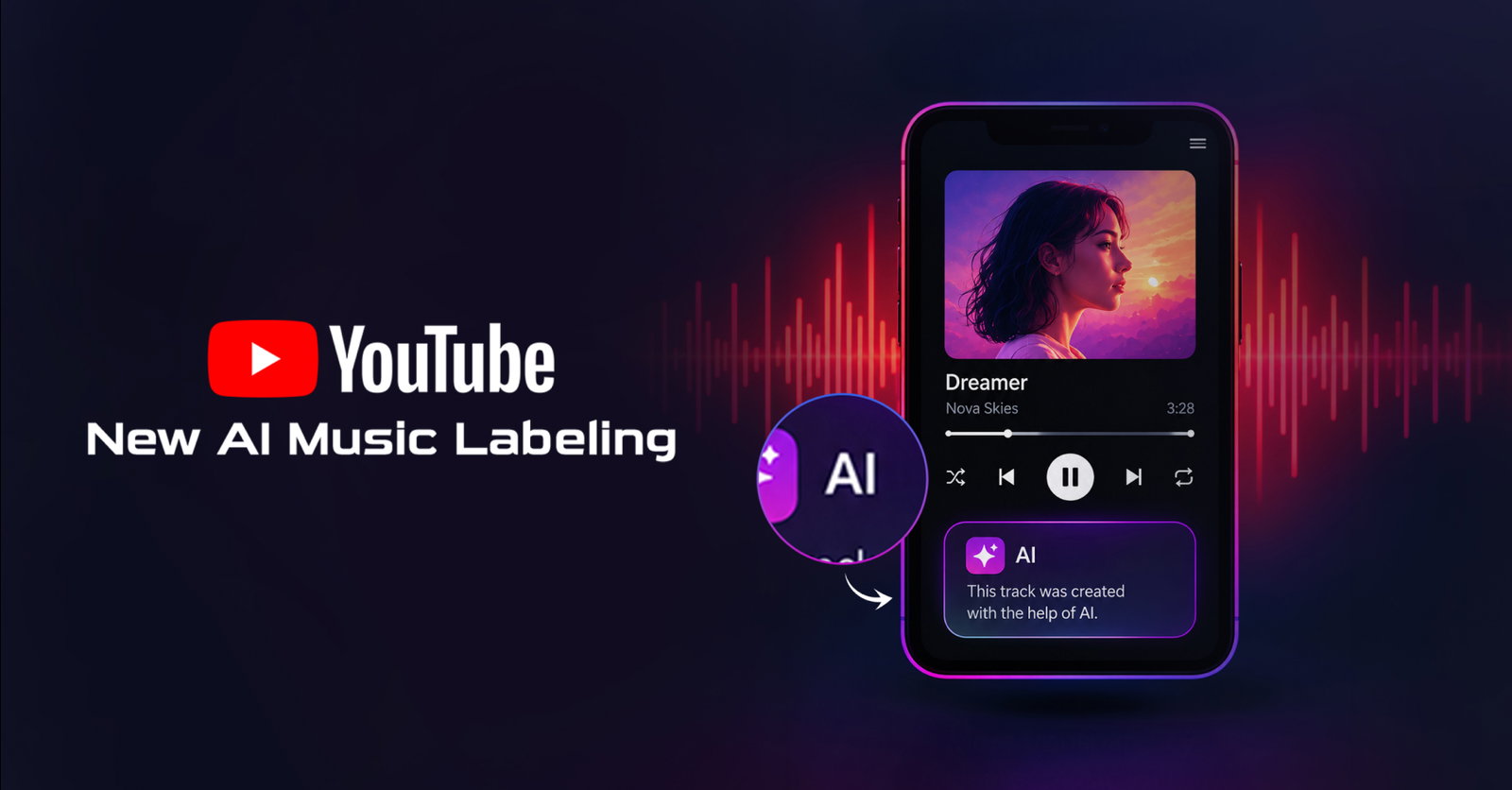
On October 14, 2026, YouTube Music announced a rollout of labels identifying songs created primarily with generative AI (Gen AI).
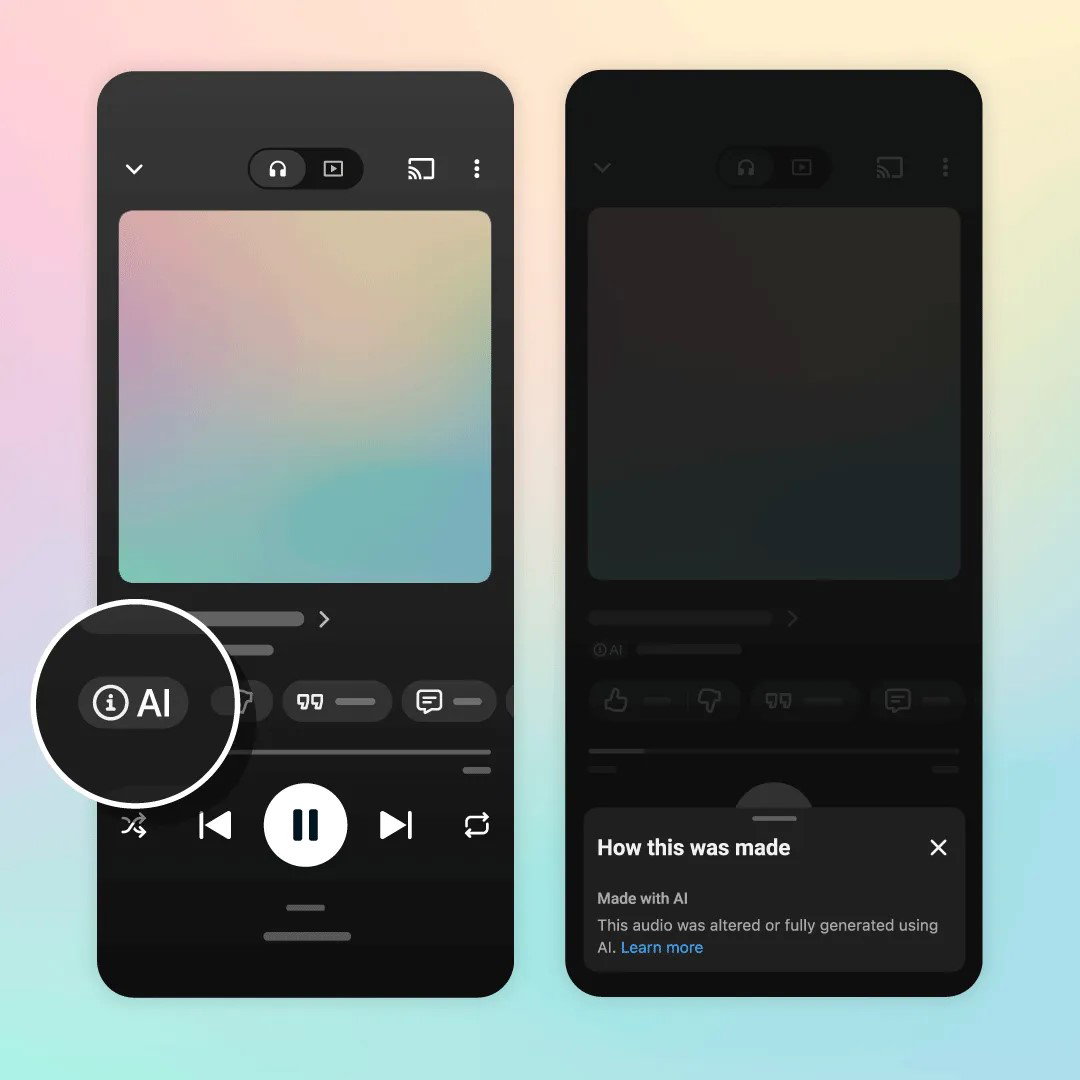
The YouTube Music AI labels appear directly on the player page when AI played a significant role in making a track. Tapping the notice opens more information about that involvement.
So, does YouTube label songs that are generated by AI? Yes, although the rollout is focused on substantial generative use, not every digital editing tool.
The labels will also reach the main YouTube app, but YouTube has not supplied a completion date. These YouTube AI music labeling rules extend existing AI content labeling practices to songs, where synthetic voices and compositions can be difficult to recognize.
What Do Fully Gen AI, Partly Gen AI, And No Gen AI Mean?
The YouTube music partner Gen AI designations cover three possibilities, as outlined in the platform’s disclosure guidance:
-
Fully Gen AI: A model generates the entire song, including composition, instruments, and vocals. Entering a prompt into an AI music generator and downloading the resulting track is one example.
-
Partly Gen AI: Generative tools contribute to lyrics, melodies, or musical layers, with humans adding their own work. Even a human-performed song with an AI-generated music video can fall into this category.
-
No Gen AI: The work contains no generative material. Standard Auto-Tune corrections and automated AI mastering are examples YouTube places here.
That distinction matters: AI-assisted production is not necessarily the same as a machine-created performance. Now comes the practical question of telling YouTube which category fits.
How Can Artists Disclose AI-Generated Music On YouTube?
Wondering how to disclose AI music on YouTube?
Under the YouTube AI-generated music disclosure process, music partners can submit classifications through DDEX music-delivery metadata or CSV templates. Eligible uploaders using YouTube Studio instead can select disclosures in its attributes section.
For CSV deliveries, the contains_ai field accepts all, partly, none, or unknown. If a partner provides nothing, YouTube treats the status as unknown unless other signals support a determination. Its own detection systems may still designate a track fully or partly generative.
That combination of self-reporting and detection is a practical safeguard, but it does not guarantee every song will be classified correctly.
Could AI Music Labels Help Listeners But Hurt Artists?
The benefit is informed choice.
Listeners can appreciate a fully synthetic song without mistaking a generated performance for a real singer. Artists who combine traditional recording with AI voice tools also gain a way to describe their process instead of being lumped together with fully automated tracks.
There is a trade-off: a visible AI notice might cause some listeners to skip a track before hearing it. Conversely, limited declarations and imperfect detection could leave gaps in transparency. Crucially, a label explains creation methods; it does not establish copyright ownership, consent, or song quality.
As concerns over AI slop grow, consistent descriptions may help, but the real test is whether listeners trust what appears beside the play button.
How Does YouTube Compare With Other Music Platforms?
Spotify introduced AI Persona badges for synthetic artist identities, alongside AI Credits for music-making disclosures. Its focus distinguishes who appears to be performing from how a song was produced.
Deezer has moved further toward listener control, announcing a toggle planned before the end of 2026 to exclude AI-generated music from discovery. Apple Music has also introduced metadata-based AI transparency tags for music deliveries.
Compared with those measures, YouTube emphasizes on-player context rather than a new filtering switch. Whether this is enough may depend on how readily listeners can recognize and act on the labels.
Topics For More Insights
The Final Note
Let the music speak but label it first. YouTube is not asking listeners to stop enjoying machine-made music. It is giving them more information about what went into the song. That is a useful starting point for artists who experiment with generative tools and listeners who value authenticity. Still, good labeling depends on honest disclosures and reliable detection. The next question is whether transparency changes what people choose to play.
Frequently Asked Questions
Will A YouTube AI Music Label Affect Monetization Or Recommendations?
YouTube has not announced a special recommendation or royalty penalty tied to its new music-specific labels. Its broader creator guidance has said that simply disclosing AI use does not, by itself, affect video recommendations or monetization eligibility. However, separate rules covering misleading content, impersonation, copyright, and repetitive uploads still apply. Creators should avoid assuming that declaring a track as AI-generated grants them the rights to reproduce a person’s voice or to monetize copyrighted material.
Can YouTube Detect AI-Generated Music Without An Artist’s Disclosure?
Yes. YouTube says it can use additional signals to identify generative involvement even when a music partner leaves the relevant metadata blank. In that case, the initial declaration is treated as unknown unless those signals allow the platform to make a determination. However, YouTube has not publicly promised perfect accuracy or described a universal error rate for this music-specific system. Detection should be viewed as a supplement to accurate delivery information, not a replacement for it.
Does Using AI For A Music Video Mean The Song Is AI-Generated?
Not necessarily. YouTube’s music partner guidance includes an example in which the soundtrack is performed entirely by humans, but the accompanying video is created using a text-to-video generator. That combined release can fall under Partly Gen AI. The distinction is useful because the designation may describe generative material elsewhere in the music asset, not only synthetic singing or instrumentation. A listener should therefore check the contextual information rather than presume every flagged vocal was machine-generated.
Tue, Oct 20, 2026

Enjoyed what you've read so far? Great news - there's more to explore!
Stay up to date with the latest news, a vast collection of tech articles including introductory guides, product reviews, trends and more, thought-provoking interviews, hottest AI blogs and entertaining tech memes.
Plus, get access to branded insights such as informative white papers, intriguing case studies, in-depth reports, enlightening videos and exciting events and webinars from industry-leading global brands.
Dive into TechDogs' treasure trove today and Know Your World of technology!
Disclaimer - Reference to any specific product, software or entity does not constitute an endorsement or recommendation by TechDogs nor should any data or content published be relied upon. The views expressed by TechDogs' members and guests are their own and their appearance on our site does not imply an endorsement of them or any entity they represent. Views and opinions expressed by TechDogs' Authors are those of the Authors and do not necessarily reflect the view of TechDogs or any of its officials. While we aim to provide valuable and helpful information, some content on TechDogs' site may not have been thoroughly reviewed for every detail or aspect. We encourage users to verify any information independently where necessary.
Loading comments...