
Artificial Intelligence
Nvidia Launches Nemotron 3.5 Open Models To Power Enterprise AI Agents
Share
TL;DR
-
Nvidia introduced its Nemotron 3.5 open-weight model family, targeting enterprise AI agents across data centers, workstations, and personal computers.
-
Nemotron 3.5 Super VL features 120 billion parameters, activating only 12 billion per token through its mixture-of-experts architecture to support efficient multimodal reasoning.
-
The Nemotron 3.5 Bolt models bring specialized AI capabilities to compatible local devices, supporting coding, research, conversational assistants, and resource-efficient workflows.
-
Nvidia's open-weight approach allows businesses to fine-tune models using proprietary data, customize enterprise AI agents, and deploy them within controlled infrastructure.
-
Nemotron 3.5 aims to improve enterprise AI scalability, inference efficiency, and operational flexibility, although real-world performance depends on hardware, workload complexity, and security controls.
Introduction
Remember Mission: Impossible – Ghost Protocol, where Ethan Hunt and his team must operate without any usual support from the IMF? From hacking security systems to analyzing intelligence and coordinating high-stakes missions, every team member brings a specialized skill to the table.
The real magic isn't just having advanced technology. It's how different capabilities work together to get the job done, even with limited resources.
Now, imagine bringing that same approach to enterprise AI!
Today's AI agents can analyze complex documents, write code, automate workflows, and execute tasks across business systems.
However, deploying these agents at scale isn't exactly a walk in the park. Businesses must balance powerful reasoning capabilities with computing costs, data security, and infrastructure limitations. After all, not every mission needs the entire IMF!
That's where Nvidia's Nemotron 3.5 open models come into play. Announced recently, the lineup introduces Nemotron 3.5 Super VL alongside two smaller Bolt models, enabling businesses to deploy specialized AI agents across enterprise data centers, workstations, and personal computers.
With multimodal reasoning, customizable open weights, and optimized inference efficiency, Nvidia aims to help enterprises assign the right AI capabilities to the right tasks without unnecessarily consuming computing resources.
So, is Nemotron 3.5 the specialized AI task force enterprises have been waiting for? Let's find out!
What Is Nvidia Nemotron 3.5, And Why Does It Matter?
Nvidia Nemotron 3.5 is a family of open-weight AI models designed to support agentic workflows, complex reasoning, and autonomous task execution. Unlike traditional AI assistants that primarily respond to prompts, agentic systems can interact with external tools, retrieve information, and complete multistep tasks with limited human intervention.
The latest expansion introduces three models designed for different computing environments:
Nemotron 3.5 Super VL: A 120-billion-parameter multimodal model built for specialized enterprise agents, complex document analysis, visual understanding, and advanced reasoning.
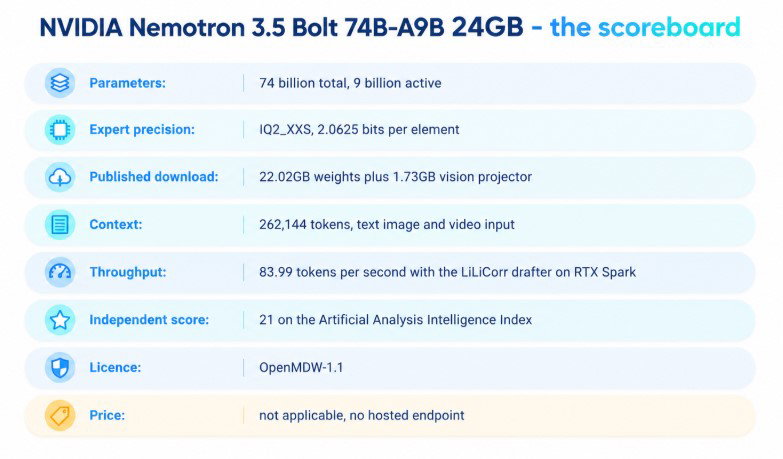
Nemotron 3.5 Bolt 74B-A9B 24GB: A lightweight, optimized model designed to run locally on compatible Nvidia RTX systems and workstations.
Nemotron 3.5 Bolt E4B 4GB: A compact model designed for conversational agents, voice assistants, and embedded applications.
The lineup complements Nvidia's existing Nemotron models, including Lightning for high-throughput tasks and Ultra for demanding reasoning workloads.
What makes this approach interesting is its flexibility. Businesses can deploy larger models for complex operations while using smaller, more efficient alternatives for routine tasks.
Rather than depending on a single powerful model for everything, organizations can match AI capabilities to their workloads, infrastructure, and operational requirements.
Nvidia Nemotron 3.5 Super VL: A Powerful Multimodal Reasoning
At the center of the announcement is Nemotron 3.5 Super VL, a vision-language model designed to handle demanding enterprise workflows.
The model contains 120 billion parameters but activates only 12 billion for each token it processes. This is possible through a mixture-of-experts (MoE) architecture, which selectively uses different neural network components depending on the task.
In simpler terms, the model doesn't need to activate its entire architecture for every request, improving computational efficiency without sacrificing its broader capabilities.
Nvidia has also combined Mamba-2 layers, Transformer-based attention, and multimodal processing to support tasks involving text, images, documents, and video.
Its notable capabilities include:
-
Multimodal understanding: Processes text, images, charts, tables, PDFs, and video content within connected workflows.
-
Advanced reasoning: Follows complex instructions, interprets contextual information, and supports multistep decision-making.
-
Tool integration: Interacts with external applications and software tools to execute business operations.
-
Long-context processing: Supports context lengths of up to one million tokens, subject to deployment configurations.
-
Efficient inference: Uses techniques such as speculative decoding and NVFP4 quantization to optimize resource consumption.
According to Nvidia's published testing, Nemotron 3.5 Super VL delivers up to five times higher throughput than certain competing open models in its class on evaluated agentic workloads.
However, actual performance depends on hardware configuration, workload complexity, and deployment settings. These benchmark results should not be interpreted as a guaranteed fivefold improvement across every enterprise application.
Nevertheless, the combination of multimodal intelligence and optimized processing makes Super VL particularly relevant for organizations building sophisticated AI agents.
How Nvidia Nemotron 3.5 Powers Enterprise AI Agents
Enterprise AI agents often need to perform several connected tasks rather than answer isolated questions.
Consider an insurance company processing hundreds of claims daily. An AI agent might need to read submitted forms, extract information from scanned documents, compare details with internal policies, identify inconsistencies, and prepare recommendations for human reviewers.
Traditionally, such workflows may require multiple AI models and software systems working together. Nemotron 3.5 Super VL is designed to simplify that process by combining visual understanding, reasoning, and tool interaction within a single model.
This creates opportunities across several industries.
-
Financial services: AI agents can extract transaction details, analyze receipts, review credit agreements, and support financial reporting.
-
Cybersecurity: Specialized agents can investigate potential vulnerabilities, analyze threat intelligence, and help security teams prioritize incidents.
-
Software development: Coding agents can inspect repositories, identify errors, recommend changes, and assist with debugging.
-
Healthcare administration: Agents can interpret medical claims, process documentation, and support revenue cycle management, subject to appropriate oversight and compliance controls.
-
Enterprise knowledge management: AI agents can search internal systems, interpret complex documents, and retrieve relevant information from multiple applications.
While Nemotron 3.5 Super VL brings advanced reasoning and automation to complex enterprise workflows, not every AI task requires large-scale computing infrastructure. Recognizing this, Nvidia is extending its agentic AI capabilities beyond data centers, making them accessible on smaller, more resource-efficient devices.
Nvidia Nemotron 3.5 Bolt Brings AI Agents To Personal Computers
While Super VL targets demanding enterprise applications, Nvidia is also extending agentic intelligence beyond centralized data centers. Its two Nemotron 3.5 Bolt models are designed to support local AI execution on smaller computing systems.
The larger model, Nemotron 3.5 Bolt 74B-A9B 24GB, uses native 2-bit quantization to operate within a 24GB memory footprint on compatible hardware. This makes it suitable for local tasks such as conducting research, generating content, and debugging software without necessarily transferring the entire workload to cloud-hosted AI services.
Topics For More Insights:
Meanwhile, Nemotron 3.5 Bolt E4B 4GB targets resource-constrained environments, including interactive assistants, embedded interfaces, and conversational applications. Its smaller memory requirements could make agentic capabilities accessible across a wider range of compatible Nvidia-powered devices.
The practical advantage is greater control over where AI processing occurs. For example, an enterprise employee could use a locally deployed AI agent to summarize permitted internal documents or assist with development tasks without automatically sending those documents to an external cloud provider.
Local processing does not eliminate security risks, but it can help organizations reduce unnecessary data transfers and design stronger privacy controls.
This shift also suggests that future AI agents may operate across multiple computing environments, with smaller models handling everyday activities and larger models addressing more complicated assignments.
Conclusion
Nvidia's Nemotron 3.5 launch represents another step toward making powerful AI agents more adaptable, efficient, and accessible. With Super VL supporting complex enterprise reasoning and Bolt extending agentic capabilities to local devices, businesses now have more options for deploying AI across different workloads.
The open-weight approach also gives organizations greater flexibility to customize models and manage sensitive information within their preferred infrastructure. While challenges involving security, accuracy, and deployment costs remain, Nemotron 3.5 signals an important evolution in enterprise AI: from systems that primarily provide answers to agents designed to execute meaningful work.
The question is no longer simply how intelligent AI models can become, but how effectively organizations can put that intelligence to work.
Frequently Asked Questions
How Does Nvidia Nemotron 3.5 Super VL Balance Multimodal Reasoning Capabilities With Computational Efficiency?
Nemotron 3.5 Super VL uses a mixture-of-experts (MoE) architecture that activates only 12 billion of its 120 billion parameters per token. Combined with hybrid neural network layers and optimized inference techniques, this approach reduces computational overhead while supporting complex multimodal reasoning and enterprise agent workflows.
Can Nvidia Nemotron 3.5 Models Be Fine-tuned For Industry-specific Enterprise AI Applications?
Yes. Nvidia's open-weight approach allows enterprises to customize Nemotron 3.5 models using proprietary datasets and specialized training techniques. Organizations can adapt these models for applications such as financial document processing, cybersecurity investigations, and automated compliance workflows while maintaining greater control over model deployment and sensitive business data.
What Are The Key Technical Challenges Of Deploying Nvidia Nemotron 3.5 In Production Environments?
Deploying Nemotron 3.5 requires careful consideration of GPU memory, inference latency, model optimization, and integration with existing enterprise systems. Organizations must also address prompt injection vulnerabilities, hallucinations, access permissions, and agent reliability to ensure that autonomous workflows remain secure, accurate, and operationally efficient.
Thu, Oct 22, 2026

Liked what you read? That’s only the tip of the tech iceberg!
Explore our vast collection of tech articles including introductory guides, product reviews, trends and more, stay up to date with the latest news, relish thought-provoking interviews and the hottest AI blogs, and tickle your funny bone with hilarious tech memes!
Plus, get access to branded insights from industry-leading global brands through informative white papers, engaging case studies, in-depth reports, enlightening videos and exciting events and webinars.
Dive into TechDogs' treasure trove today and Know Your World of technology like never before!
Disclaimer - Reference to any specific product, software or entity does not constitute an endorsement or recommendation by TechDogs nor should any data or content published be relied upon. The views expressed by TechDogs' members and guests are their own and their appearance on our site does not imply an endorsement of them or any entity they represent. Views and opinions expressed by TechDogs' Authors are those of the Authors and do not necessarily reflect the view of TechDogs or any of its officials. While we aim to provide valuable and helpful information, some content on TechDogs' site may not have been thoroughly reviewed for every detail or aspect. We encourage users to verify any information independently where necessary.
Loading comments...